
The Algorithm Made Brands Faster. CultureCode Makes Them Mean Something.
Algorithms flatten relevance and resonance. A new tool from Horizon Futures pushes back.

This post was written by Courtney Mota, member of Horizon Media’s Future of Consumer & Culture team.
You’ve seen the ads. Six-fingered hands. Voiceovers that land an octave off. Brands catching a trend two months after it died. We’ve started calling it slop, which is a perfect word for something that’s short, ugly, and slightly embarrassing for everyone involved.
Some brands, like Liquid Death, are using the AI slop aesthetic deliberately. They know what they’re doing, and the slop is the wink. But others are just producing it.
The interesting thing isn’t that AI made this possible. It’s that we’ve collectively stopped noticing the difference between looks finished and means something. AI rushes in to make finished things faster than anyone can ask whether they mean anything. And we’ve started chasing virality, or the appearance of relevance, as a substitute for resonance. The output is up, but the specificity is down.
This is where cultural strategy comes in, and where it’s most under-leveraged.
The job of cultural strategy, at its essence, is built on specificity. The wrong question – and the one AI answers brilliantly in thirty seconds – is what’s trending right now. The right question is harder: what’s trending right now that this particular brand has a credible reason to say something about? Answering that means actually knowing what the brand stands for, what people actually believe (often something different), and where the cultural air is moving. And then deciding how those three things should meet.
“In a world where AI is very smart and capable of doing so many things, the things that make us human will become much more important.”
– Daniela Amodei, President and Co-Founder of Anthropic (Claude)
A model can’t do that. Not because models aren’t smart. They are. But because to a model, Patagonia and Columbia Sportswear are roughly the same. The model doesn’t know which one your audience trusts. It doesn’t know what they mean. As production speeds accelerate, and costs go down, AI is making the work of discernment more important, not less – and that work is worth getting right.
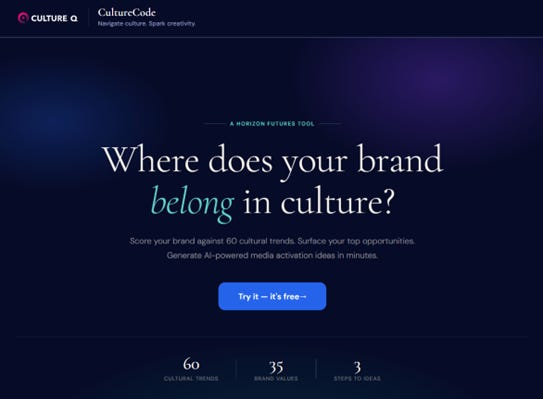
This is the premise behind CultureCode, a tool we built inside Horizon Futures and have just put a scaled-down version of online. The idea was to prove something to ourselves: that AI in strategic work isn’t valuable for generating ideas faster, it’s valuable for forcing rigor before you let it generate anything. You put in a brand. You pick three values from a 35-value taxonomy. The tool scores that value profile against 60+ cultural macrotrends and surfaces those with the strongest fit, each labeled by alignment type and the shared value(s) driving the connection. From there, you can take any trend into idea generation, framed as media strategy. Channels, formats, targeting logic, white space against competitors.
The demo we’ve put online is the lighter version. Internally, we run a fuller one that takes consumer perception, aspirational values, and audience signals into account, and flags credibility gaps when a brand’s values, perception, and ambition don’t line up. The demo will give you a feel for the framework. The fuller version is a conversation.
Our goal in making CultureCode wasn’t to make culture-by-machine. It was to put a framework in front of the model so the model can’t generate average. The framework is the part we own. The AI just makes it move faster.
If this resonates, the demo is here. Spend a few minutes with a brand you have opinions about. The point isn’t to be impressed by the AI. It’s to notice what happens when a framework forces the AI to produce something specific.
Because knowing what Patagonia means is the job. AI just made it more obvious that it’s one worth doing.